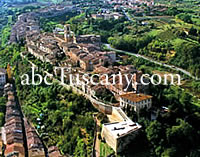
Colle di Val d' Elsa - lies
in the heart of Tuscany, in a strategically favourable position
near the towns of Sienna, Florence and Volterra, on the via
Francigena which connects Rome with the North.
The town was originally made up of
three independent areas with separate structures and urban
arrangements: Borgo di Santa Caterina, Castello di Piticciano
and Piano. The two oldest settlements, privileged seats of
the ruling class, are both situated on the same hilly ridge
which runs from east to west and, separated by a wide valley,
dominate the valley floor which is home to the third "hamlet",
Piano, which has a more recent urban structure built specially
to accommodate manufacturing activities.
The first documents in which Colle is recorded date back
to the 10 century but it was only at the end of the 12 century
that the town gradually began to develop its independence
and a political identiy: the first municipal charters are
dated 1307.
The urban area was already quite extensive in the Middle
Ages and, in addition to the high district, included Piano
(the plain) which ran along the old millraces, the artificial
canals of the River Elsa, and was populated by numerous water-powered
buildings, such as mills, paper mills and fulling mills, which
were fundamental to the town's economy, encouraging industrial
development.
The history of Colle di Val d'Elsa is characterised by frequent
episodes of violence. One of the most famous of these was
the batde of 1269 between the Guelphs and Ghibellines, which
had considerable repercussions on the political balance in
Tuscany. Another important event was the siege by the troops
of the Duke of Calabria, suffered in defence of Florentine
territory in 1479, which led initially to serious destruction
and then to improvement of the fort system.
During the Sixteenth century, Colle di Val d'Elsa was still
part of the Florentine sphere, but was gradually gaining power,
mainly thanks to the de Medici family and to the illustrious
people of Colle who handled the town's administration. After
the Sienna war and the constitution of the grand duchy of
Tuscany, in 1592 with the Bill passed by Clemente VIII, Colle
became the seat of a new diocese. In the 17 century, the Usimbardi
family opened a new chapter in the modern history of Colle
di Val d'Elsa. At the beginning of this new era the paper
industry was replaced by the new iron and glass industries.
The production of glass followed by crystal characterised
the industrial activiy of Colle di Val d'Elsa, which became
known as the Bohemia of Italy in the 19 century. Today it
is an authentic "Crystal City", producing 15% of
the world's crystal.
How to reach Colle Val d' Elsa: From Siena take direction
Florence, after 18 Km you will find the exit for Colle val
d'Elsa
Where is Colle val d' Elsa: is located in the north/west
of Siena province, in the border with the province of Pisa.
See the map
Nearby: Visit San Gimignano, Monteriggioni, Casole
d' Elsa, Chianti area
Distances: Siena 23 Km - Florence 45 Km - Pisa 90
Km - Arezzo 110 Km
Correct name is Colle Val d' Elsa
Common mistakes are Col, Colla, Cole, valdelsa, Elisa,
Elza
|
 Colle Val d' Elsa
- Siena - Tuscany Italy
Colle Val d' Elsa
- Siena - Tuscany Italy

 Colle Val d' Elsa

