|
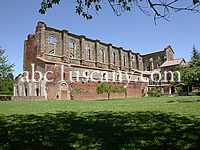 This
was the border between the States and the Dioceses of Volterra
and Siena. This
was the border between the States and the Dioceses of Volterra
and Siena.
From the 10th century to almost the end of the 11th century,
Chiusdino, Monticiano and Sovicille came under the jurisdiction
of the Bishops of Volterra, but gradually their influence
was ceded to the Bishops and the authorities of the State
of Siena, who alternatively exercised their sovereignty over
the area until the end of the 15th century.
Murlo ( or, more correctly called the Diocese of Murlo),
clearly a Bishopric as one can see from the name, was always
tied to Siena, as were Casciano, Crevole, Montepescini, Resi,
Vallerano, Montepertuso, Lupompesi la Pieve a Carli, Montorgiali,
la Befa.
Of the four Municipalities of this valley, the fortifications
in the four principal towns are well worth visiting, the castles
of Frosini (Chiusdino), Tocchi (Monticiano), Crevole (Murlo)
Capraia (Sovicille).
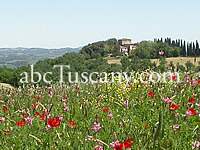 Very
much attached to their own splendid towns - Murlo, Monticiano,
Chiusdino, Sovicille - the people of the Val di Merse have
always tried to protect from foreign invasion the thousands
of acres of forests, the gently rolling hills, the thickets
of holm-oaks, the chestnuts, the pines, the laurel, the berries,
the oaks, the hornbeam, creepers and brambles which cascade
into the white river Merse, and which continue to reproduce
day after day and are a special feature of this valley. It
is the river. which throughout its history, has fed many mills
or fulling mills, and which seems to exist only to promote
the flora which naturalists define as "extraordinary
". and to encourage the increase of fauna, which even
strangers to this area are amazed to find, and greatly admire. Very
much attached to their own splendid towns - Murlo, Monticiano,
Chiusdino, Sovicille - the people of the Val di Merse have
always tried to protect from foreign invasion the thousands
of acres of forests, the gently rolling hills, the thickets
of holm-oaks, the chestnuts, the pines, the laurel, the berries,
the oaks, the hornbeam, creepers and brambles which cascade
into the white river Merse, and which continue to reproduce
day after day and are a special feature of this valley. It
is the river. which throughout its history, has fed many mills
or fulling mills, and which seems to exist only to promote
the flora which naturalists define as "extraordinary
". and to encourage the increase of fauna, which even
strangers to this area are amazed to find, and greatly admire.
A visit to the Val di Merse certainly cannot be limited to
visiting the splendid monuments, the masterpieces of the Sienese
school found in the ancient villages, and the towers of white
alberese stone. The Val di Merse is above all a poetic countryside
of unspoiled beauty.
Areas of Siena
 Val di Merse
Map
Accommodations
Val di Merse
Map
Accommodations
|

 Val di Merse - Siena - Tuscany Italy



