|
 The
Sienese Crete extend along the lath's of the rivers Arbia,
Ombrone and Asso, in an area which stretches from Siena to
Montepulciano and broadly speaking includes the Municipalities
of Asciano, Monteroni, Buonconvento and San Giovanni d'Asso. The
Sienese Crete extend along the lath's of the rivers Arbia,
Ombrone and Asso, in an area which stretches from Siena to
Montepulciano and broadly speaking includes the Municipalities
of Asciano, Monteroni, Buonconvento and San Giovanni d'Asso.
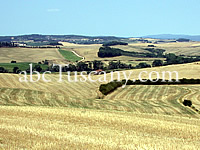
The countryside is characterised by the almost non-existence
of trees, undulating bare hills with whitish outcrops and
rugged slopes, solitary houses on the crests of hills with
lonely clumps of juniper and cypress trees.
The variations of colour, the play of light, the cultivated
fields which create a special panoramic effect and fantastic
horizons which catch the imagination. Vie farming activity
in this area, has always been mainly the cultivation of cereals
by tenant fanners. With the ending of the lease farming system,
pastoral farming has taken over, and therefore, the farms
in this area now produce excellent quality pecorino cheese,
milk and specialise in the gathering of white truffles and
the cultivation of olives.
 There
still remains a special interest in the working of clay for
the production of building materials and terracotta products
made by craftsmen. The towns still preserve, unaltered, the
outline of their ancient heritage, with the remains of old
fortifications and centres which are completely medieval in
layout. There
still remains a special interest in the working of clay for
the production of building materials and terracotta products
made by craftsmen. The towns still preserve, unaltered, the
outline of their ancient heritage, with the remains of old
fortifications and centres which are completely medieval in
layout.
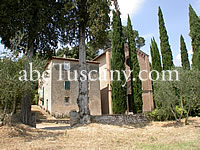
The countryside is rich with farm houses, farms, old castles,
churches, palaces and manorhouses. Imagine taking a journey
starting in Siena; one would arrive at the important centre
of Rapolano, rich with its thermal springs and quarries of
travertine marble, surrounded by the castles of Modanella,
Serre, Poggio S. Cecilia, San Gimignanello.
From there one would move on to Asciano with its Etruscan
museum and the nearby imposing Castello di Gallico, Chiusure
and the famous Abbey of Monte Oliveto Maggiore. From there
one can reach Trequanda, then Petroio with its terracottas
and then on to Castelmuzio, Montisi, San Giovanni d'Asso where
there is an annual truffle fair-Descending towards the green
valley of the Arbia, and travelling along the State Highway
Cassia and following the route of the ancient Francigena,
one arrives at Buonconvento with its historic medieval, well
preserved town centre. Turning in the direction of Siena,
one crosses the ancient bridge over the river Arbia at Borgo
d'Arbia, where, after a short distance one finds Lucignano
and Monteroni with its imposing tower of the ancient mill,
then the massive and isolated Grancia di Cuna and lastly one
arrives at Isola d'Arbia when one can admire the splendid
countryside of the Crete of Camposodo with its view of the
city of Siena.
Areas of Siena
 Val d' Arbia
Map
Accommodations
Val d' Arbia
Map
Accommodations
|

 Val d' Arbia - Siena - Tuscany Italy



